
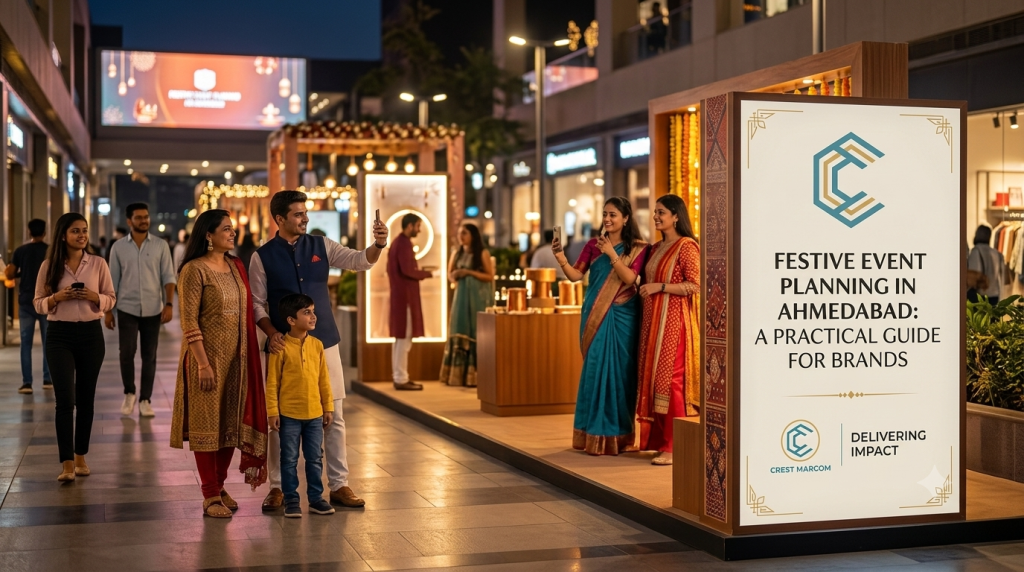
Festive event planning is the process of designing and executing an on-ground brand experience decor, lighting, layout, and audience flow timed around a festive season to convert footfall into measurable business outcomes. In Ahmedabad, where Navratri and Diwali bring some of the year’s highest retail and mall footfalls, doing this well is the difference between a forgettable storefront and a space people actively seek out.
Every year, the festive season transforms Ahmedabad’s commercial landscape as the malls along SG Highway fill up, Prahlad Nagar’s corporate offices plan their year-end celebrations, and CG Road’s retail stretch competes hard for shopper attention. For years, the standard playbook was discounts and text-heavy banners. That playbook doesn’t work anymore. Shoppers have seen a thousand “50% off” signs. What they haven’t seen is a space worth photographing.
This guide covers how brands in Ahmedabad retail, automotive, and corporate alike can plan festive events that hold up once the crowd walks in.
Why Discounts Don’t Work Anymore
For decades, the holiday marketing formula was simple: fill the newspaper with discount ads, hang a few balloons, done. That approach fades into the background now, and it’s not hard to see why. Most shoppers, especially the younger crowd browsing SG Highway and Prahlad Nagar malls, spend hours a day scrolling Instagram and Pinterest. Their bar for what looks “worth stopping for” has moved. A space either looks curated and intentional, or it looks like every other stall on the block.
The practical implication: your event needs to function as a destination, not a backdrop. When people want to pause, look around, and take a photo, they end up sharing it and that unpaid, organic reach from a genuinely good-looking setup is something no ad budget can fully replicate.
Design Choices That Actually Cut Through the Ahmedabad Festive Crowd
Move away from synthetic decor : Plastic hangings and balloon arches show up at nearly every stall during festive season across Ahmedabad’s markets, which is exactly why they no longer stand out. What does stand out: minimalist layouts, considered color palettes, and warm custom lighting that feels deliberate rather than default. If you’re running the same decor concept across multiple branches in the city, the real challenge isn’t the design itself, it’s finding a vendor network reliable enough to execute it consistently at every single location.
Add movement: A static banner is easy to ignore in a crowded venue. LED screens, interactive lighting, or a slow-moving canter or float activation through busy stretches like CG Road or Maninagar pulls attention in a way flat signage simply can’t. Moving visuals catch the eye before the brain has time to filter them out, that’s the whole point.
Matching the Plan to the Business
Not every business needs the same festive setup. What works for a mall doesn’t work for a corporate office, and what works for a showroom is different again.
Retail hubs and malls: The goal here is dwell time the longer a family, the longer they spend. That means photo-friendly walkways and interactive corners, not just a decorated entrance. If you’re running this across several Ahmedabad locations, visual consistency matters as much as the design itself; a mismatched brand experience across branches undercuts the premium feel you’re going for.
Automobile showrooms: The objective is testing drives and bookings, particularly around the auspicious dates that drive a large share of annual vehicle sales in the city. A well-lit 30-day showcase in a high-traffic commercial hub, paired with a simple digital lead-capture desk right next to the car, tends to outperform a flashier setup with no clear next step for the visitor.
Corporate milestones: These events are about relationships, not footfalls. Professional staging, comfortable seating, and audio-visual setups that don’t glitch mid-presentation matter more than novelty. Coordinating something like this for a large Ahmedabad workforce comes down to two things that rarely get enough attention in advance: venue logistics and a schedule that’s timed to the minute, not the hour.
The Timeline: What to Lock in and When
45 days out: Finalize the theme, the budget, and the overall concept. This is the point where changes are still cheap.
30 days out: Confirm on-ground vendors and secure the local compliance clearances that busy festive-season venues often require.
15 days out: Begin fabrication and start technical checks on-site.
Event day: Focus shifts entirely to crowd flow and live monitoring.
A few things are worth getting right within that window. First, map the physical layout carefully entry points, interactive zones, and display areas should let people move without creating bottlenecks near the busiest corners. Second, never use cheap fabrication materials for structures the public will be standing near; verify that power lines can handle festive lighting loads before event day, not during it. Third, run a full technical dry run 24 to 48 hours before guests arrive test microphones, check LED video mapping, and make sure ground staff know how to handle a glitch calmly rather than visibly panicking in front of a crowd.
Measuring Whether It Actually Worked
A crowded event looks good in photos. Whether it was worth the budget is a separate question, and it comes down to three numbers.
|
What to Track |
What It Tells You |
|
Footfall count: |
The raw pull of your setup did people stop? |
|
Social media reach: |
Organic tags, check-ins, and mentions free reach that lowers acquisition cost |
|
Direct conversions: |
Test drives booked, orders placed, sign-ups collected the number that justifies the spend |
Footfall without conversions is a vanity metric. Track all three together, and you get a real picture of return on investment rather than just a good-looking crowd photo.
Bringing It Together
Good festive event planning comes down to balancing creative ambition with disciplined execution. The brands that stand out in Ahmedabad this season won’t be the ones with the biggest discount, they’ll be the ones whose space was worth walking into.
Whether you’re planning a single corporate celebration or a multi-location retail rollout across the city, the details vendor reliability, timeline discipline, and design that photographs well are what separate a forgettable setup from one people remember. If you’d rather hand off the vendor negotiations, design drafts, and on-ground logistics to a team that already knows Ahmedabad’s venues and compliance requirements, Crest Marcom’s event team can take that off your plate.
Our Featured Question
How far in advance should festive event plans start in Ahmedabad?
At least 45 days before launch. Vendor availability and compliance approvals get tighter closer to Navratri and Diwali, so locking in the concept and partners early avoids last-minute compromises.
What’s the most common mistake brands make with festive decor?
Using the same generic decorations, plastic hangings, standard balloon arches that every other stall in the market is already using. Differentiation comes from a distinct visual concept, not from adding more decoration.
Which type of festive activation works best for automobile brands?
month-long showroom or mall-based display timed around auspicious dates, combined with an on-site digital lead-capture setup, generally converts better than a short, high-spend event with no follow-up mechanism.
How do you measure the ROI of a festive event?
Through three combined metrics: footfall, organic social reach, and direct conversions such as bookings or sign-ups. Footfall alone doesn’t indicate business impact conversions do.
Does mall activation need a different approach than a corporate event?
Yes. Mall and retail activations should prioritize interactive, photo-friendly zones to extend family dwell time. Corporate events need a more restrained, professional setup built around relationship-building rather than crowd size.
