
How Search Habits Have Shifted for Buyers
Think about how you used to search for industrial suppliers, commercial real estate, or enterprise software. In the past, you would type a few keywords into Google, scroll past the ads, open several results, and compare features, pricing, and company credentials across different websites.
Today, however, many decision-makers and high-intent consumers are using a much more direct way to find answers.
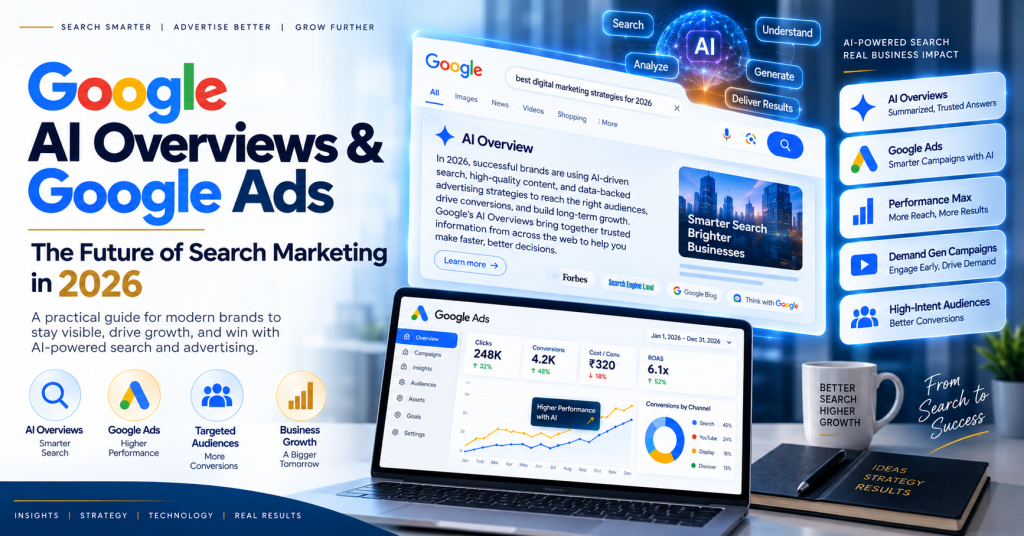
With Google AI Overviews and Gemini becoming a bigger part of the Google search and advertising experience, search is moving beyond a simple list of links. As a result, Google can now bring information together from multiple sources and present a synthesized answer at the top of the search results, often with links users can explore for more detail.
Why Marketing Leaders Need an Operational Update
For business owners, CMOs, and agency leaders, this structural shift means the old playbook needs an immediate update. Focusing only on keyword density or manual CPC bidding is no longer enough when users can get complete answers before they ever reach traditional organic listings.
Therefore, modern brands must understand how generative search works, how Gemini is changing Google Ads, and how to build a unified organic and paid strategy around it.
The Core Mechanics Behind Google AI Overviews
To create content that has a better chance of being referenced in AI Overviews, it helps to understand how Google gathers and organizes information behind the scenes.
The Query Fan-Out Process Explained
When a user types a multi-part commercial question, such as ‘What is the most durable industrial flooring material for a pharmaceutical cleanroom with heavy forklift traffic?’, the system does not execute a single database lookup. Instead, Gemini breaks the inquiry into several distinct semantic sub-queries simultaneously:
- Sub-query A: Cleanroom chemical resistance standards for pharmaceutical flooring.
- Sub-query B: Load-bearing capacity comparison between epoxy and polyurethane screed.
- Sub-query C: Maintenance timelines and installation curing cycles for heavy forklift traffic.
Consequently, the search engine executes these parallel searches across indexed web documents. In addition, it extracts relevant factual entities, verifies the claims against established industry standards, and synthesizes a direct, comprehensive summary accompanied by clickable citation cards.
Three Core Rules to Win AI Citations in GEO
Generative Engine Optimization (GEO) is the practice of structuring your digital content so that AI systems can understand, evaluate, and potentially reference it. Specifically, three areas are especially important for your team:
- High Information Gain: AI models actively filter out repetitive summaries that duplicate existing search results. For this reason, content must feature proprietary project data, field measurements, real cost breakdowns, or direct case observations that exist nowhere else.
- Direct Inverted-Pyramid Writing: Furthermore, the first two sentences beneath any sub-heading must provide a direct, unambiguous answer to the core question before expanding into nuance and background context.
- Unambiguous Entity Structure: In addition, your web pages must clearly define relationships between entities (your brand name, specific service capabilities, geographical locations, and certifications) using semantic HTML and clean schema markup.
How Gemini Transforms Modern Google Ads
Organic visibility is only half the acquisition equation. Inside the Google Ads dashboard, Gemini has fundamentally altered campaign creation, asset deployment, and auction bidding.
Real-Time Creative Adaptation in Performance Max
Performance Max campaigns can use a wider mix of assets and Google’s automation to match creative variations with different audiences and contexts. With useful audience signals and clear brand guidelines, the system can use landing-page information and campaign data to help generate and test relevant headlines, copy, and visual assets.
For instance, if a user searches for commercial office interior design on a mobile device on a weekday morning, the system can automatically serve an ad asset featuring executive boardroom layouts with a direct consultation headline. Conversely, it can serve an evening searcher a visual showcase of completed corporate cafeteria transformations.
Reaching Visual Decision-Makers Through Demand Gen
High-value buyers rarely make a purchase decision after just one text search. In fact, they often discover a business through YouTube, Google Maps, Discover, or other visual touchpoints before they ever search for a specific service. Therefore, Demand Gen campaigns are designed to engage these audiences earlier with video and image-based creative.
Sponsored Listings Placed Inside AI Overviews
Moreover, sponsored Search and Shopping placements can now appear directly around AI-powered search experiences. When someone is researching options and comparing providers, relevant ads can put businesses in front of potential customers while they are actively evaluating their choices.
Comparison: Legacy Search vs. Generative AI Search
Here is a practical comparison of how search discovery, content optimization, and campaign execution are changing across the industry:
| Strategic Dimension | Legacy Search & PPC (2020–2023) | Generative AI Search & Gemini Ads (2026) |
| User Discovery Pattern | Scanning 10 blue links and clicking multiple tabs | Reading synthesized AI Overviews with interactive follow-ups |
| Content Optimization | Keyword density, meta tags, and high-volume generic backlinks | Entity authority, proprietary information gain, and structured data |
| Ad Formats & Assets | Static text ads and manually formatted display banners | Gemini-generated dynamic creatives across Search, Shorts, & Maps |
| Paid Bidding Model | Manual CPC bidding based on exact and phrase match keywords | Value-Based Smart Bidding (Target ROAS/CPA) guided by First-Party CRM data |
| Primary Success Metrics | Impression volume, raw clicks, and total pageviews | Citation presence, qualified pipeline inquiries, and confirmed revenue |
A Complete Four-Pillar Blueprint for Brands
As search interfaces continue to change, brands can build a stronger acquisition system by focusing on four practical areas:
Pillar 1: Build Entity-Rich Content for GEO
First, move beyond short articles that simply repeat information already available elsewhere. Instead, focus your editorial effort on useful, well-researched guides that answer real commercial questions. Each pillar guide should include:
- Structured comparison tables that compare technical specifications, pricing factors, and implementation timelines.
- Real project observations, including practical mistakes to avoid and verified cost ranges.
- Clear summary paragraphs placed directly under descriptive H2 headings that allow AI search bots to extract your facts without ambiguity.
Pillar 2: Connect Offline CRM Data to Smart Bidding
Second, remember that automated bidding works strictly from the conversion signals you give it. If you optimize only for button clicks or basic form submissions, the system may end up prioritizing inexpensive leads that have little business value.
- Integrate your CRM (HubSpot, Salesforce, Zoho, or custom ERP) with Google Ads via Enhanced Conversions.
- Upload offline milestone data, such as lead qualification stages, verified property visits, completed test drives, or signed enterprise contracts.
- Consequently, this ensures Gemini Smart Bidding directs auction spend specifically toward high-value decision-makers rather than casual visitors.
Pillar 3: Unify Your Multi-Channel Brand Footprint
Third, customer discovery is no longer a straight line. For example, someone might first see a case study or short video, check your credentials through search, read your Google reviews, and later return through a brand search before becoming a customer.
- Maintain identical business name, address, phone number (NAP), and core service naming across all digital profiles.
- Furthermore, ensure, typography, and core value propositions remain consistent between video creatives, landing pages, and offline collateral.
Pillar 4: Maintain a Clean Technical Foundation
Finally, make your website easy for search engines and AI systems to crawl and understand:
- Deploy comprehensive JSON-LD structured data including Organization, Article, Service, and FAQPage schemas.
- Maintain a clean heading hierarchy (one H1 per page, followed by logical H2s and H3s).
- In addition, ensure your robots.txt file does not inadvertently block major search bots or AI crawlers from accessing your content resources.
- Optimize Core Web Vitals, ensuring mobile Largest Contentful Paint (LCP) loads under 2.5 seconds.
Conclusion: Building a Resilient Acquisition Strategy
In summary, the growth of AI Overviews and increasingly automated Google Ads is not something brands should ignore. On the contrary, it creates a remarkable opportunity for businesses that publish genuinely useful information and feed their advertising systems better data.
By creating original, useful content for generative search and improving the quality of your first-party conversion data, you can build a more resilient acquisition system across both AI-powered search experiences and paid advertising.
If you want to assess your current search visibility, prepare your website for generative search, or build Google Ads campaigns around measurable business outcomes, talk to the team at Crest Marcom Digital Marketing Services. Together, we can help you review your current setup and build a practical, future-ready acquisition strategy.
